What Integrated Literacy Instruction Looks Like in Practice
By Katie Shelton, Product Enablement Director
Lately, as I’ve been in schools supporting implementation, I’ve been hearing the same thing come up again and again.
Districts aren’t just using one or two programs during their ELA block. In many cases, it’s five, six, sometimes even seven.
There’s a program for foundational skills, another for comprehension, a separate one for writing, something for grammar, something for handwriting, and sometimes even a standalone program for phonemic awareness.
For a long time, there really wasn’t one program that could fully support everything within an ELA block, so districts did what they needed to do. They supplemented, and over time, they started supplementing the supplement.
No one made a wrong decision along the way. Every addition was made with students in mind.
But without integrated literacy instruction, it’s becoming overwhelming for teachers to juggle. It adds to prep time, increases planning demands, and creates constant transitions throughout the ELA block. And while that’s a real challenge, we also have to consider the impact on students.
What Happens When a Lesson Isn’t Connected
When you look at a typical lesson built across multiple programs, it often ends up feeling disjointed. A phonics lesson focuses on one skill, then students shift into a comprehension lesson with a completely different text. Writing may be based on an unrelated prompt, grammar is pulled from another source, and process writing lives on its own timeline.
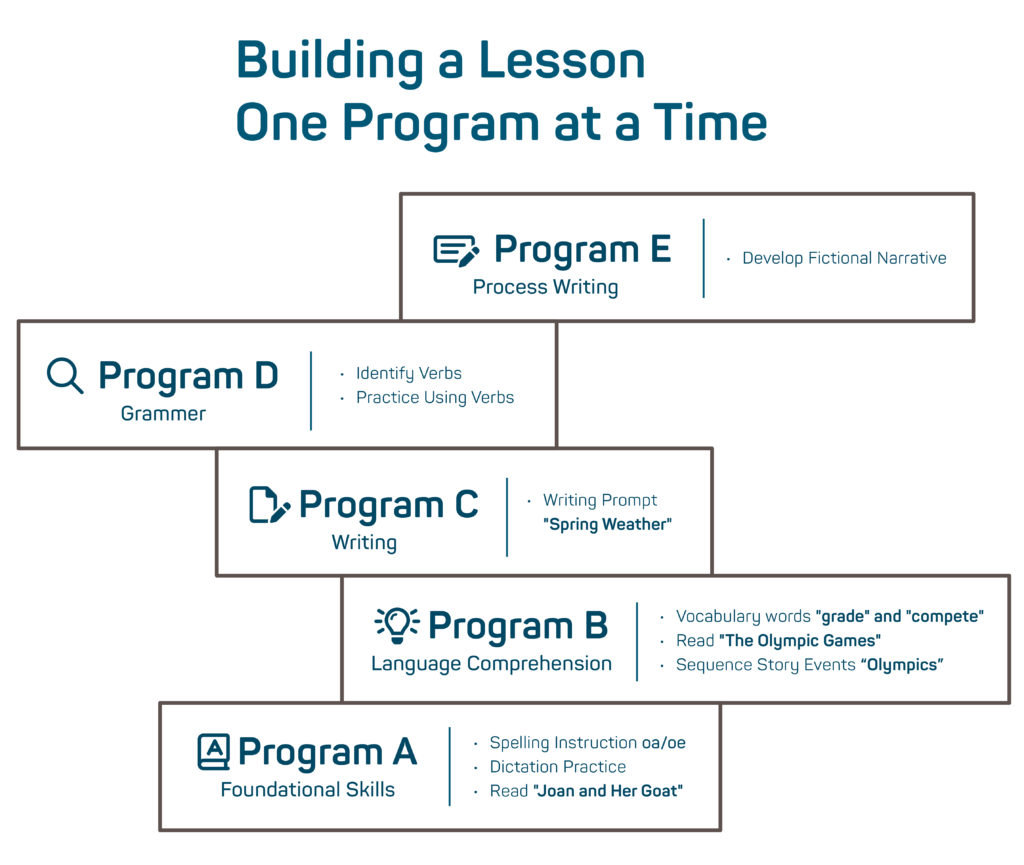
Each part might be strong on its own, but they’re not working together. Students are constantly shifting between texts, topics, and expectations, and that lack of connection makes it harder for learning to build.
Instead of reinforcing what they’ve just learned, each part of the lesson can feel like a reset.
We know students have a limited amount of working memory. When too many disconnected elements are introduced, it increases cognitive load and makes it harder for them to focus on the actual learning. Instead of going deeper, they’re often just trying to keep up.
Why Connection Matters
Students need the opportunity to build on their learning across the lesson, not just within isolated blocks. They need multiple exposures to the same skills, chances to practice in different ways, and opportunities to apply what they’ve learned beyond the moment it was taught.
That’s what helps learning stick.
When instruction is connected, students are more likely to carry their understanding from one part of the instruction to another. When it’s siloed, they may be successful in the moment but struggle to apply those skills anywhere else.
What Integrated Literacy Instruction Looks Like
Now compare that to a lesson where everything is intentionally connected.
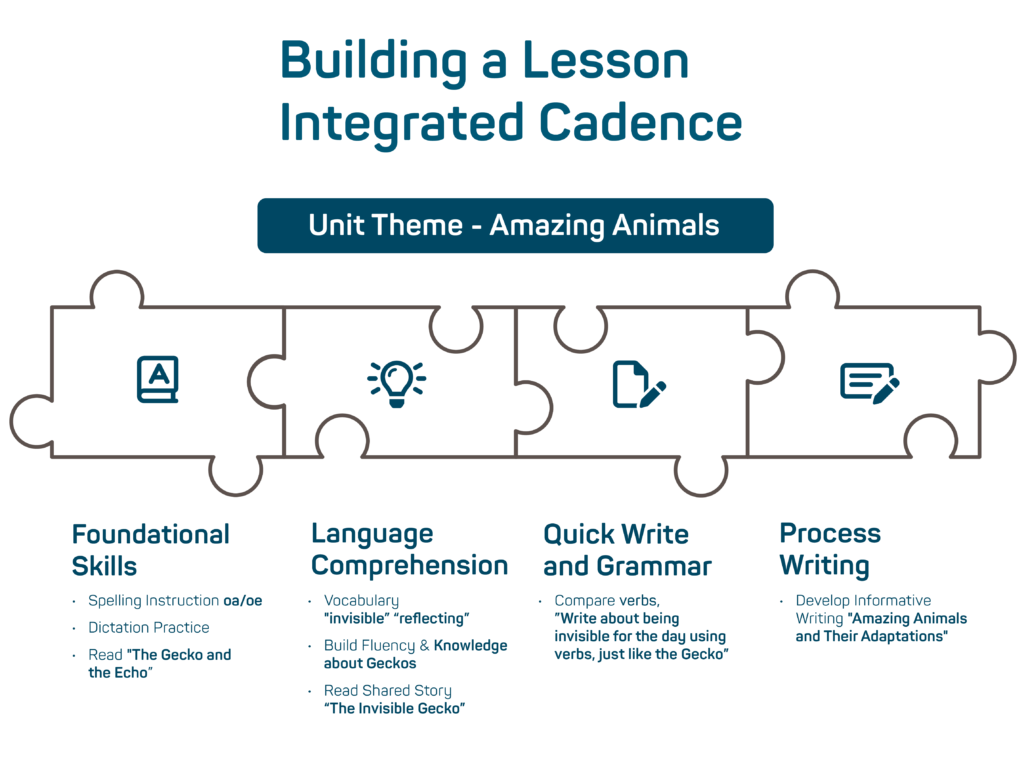
At Reading Horizons, that’s what we are building with Ascend™ Mastery. One lesson where domains are overlapping, content is connected, and students are building a deep understanding of literacy concepts.
In this kind of cadence, the phonics pattern shows up in the fluency passage, and that passage connects directly to the unit topic. The comprehension text builds on that same topic, allowing students to deepen their background knowledge instead of starting over. Vocabulary is introduced before reading and immediately applied, while grammar is pulled directly from the text students are already working with.
Writing isn’t separate from reading. It’s connected to it. Students respond to the text, extend their thinking, and carry those ideas into process writing over time.
Nothing is random, and nothing is isolated.
Students aren’t starting over each time the block shifts. They’re building, revisiting, and applying what they’ve learned in a way that leads to deeper understanding.
From What I’m Seeing in Schools
This is the part I keep coming back to in my work.
We can have strong programs, thoughtful plans, and teachers who are working incredibly hard to make it all happen. But when the lesson itself isn’t connected, we’re making the work harder than it needs to be for everyone involved.
Teachers are constantly switching gears, managing multiple resources, and trying to hold it all together.
Students feel that too.
When instruction is aligned, teachers can stay in the flow of the lesson and go deeper. Students aren’t just completing tasks or moving from one thing to the next. They’re actually building understanding in a way that makes sense.
A Shift Worth Thinking About
I’m not saying districts got it wrong. For a long time, this was the only way to cover everything within an ELA block.
But it’s worth asking whether we’re still supplementing because we truly need to, or because that’s how the system has always been built.
At a certain point, adding more doesn’t lead to better instruction. It just creates more to manage.
And what our students really need isn’t more. They need connection.
One Small Place to Start
If you’re thinking about integrated literacy instruction in your own context, a simple place to start is by looking at one day of instruction.
Lay out everything happening during your ELA block and ask:
- Where are students building on the same content or skill?
- Where are they starting over?
- Are the pieces reinforcing each other, or competing for attention?
You don’t have to overhaul all of it at once.
But even small shifts toward connection can make a noticeable difference for both teachers and students.
This blog is part of a series exploring the importance of coherence and the need for unified literacy frameworks. Read Part 1 in the series, Instructional Alignment Across Tiers: The Foundation for Lasting Literacy Growth by Trisha Thomas, President of Reading Horizons.
In Part 3, we’ll explore what national research and district leaders reveal about the growing demand for unified literacy systems—and why alignment across tiers may represent the next frontier in literacy reform.